'Stasis'
Judith Van Oeckel
- Expo
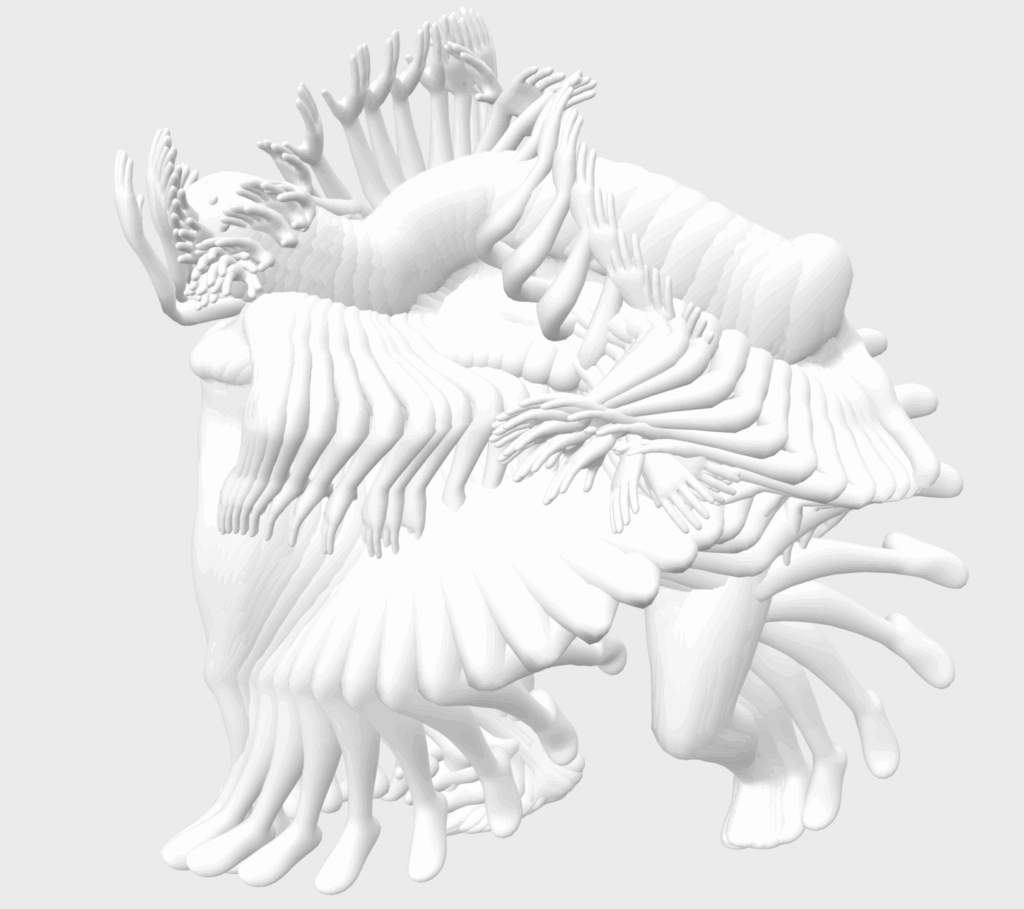
'Stasis' explores how the expressiveness and narrative of a choreography can survive when the body—through absence, limitation, or illness—is no longer the primary medium. Fleeting movements are translated into tangible, spatial sculptures using motion capture and 3D recording. The result is a performative installation in which choreography and sculpture merge and dance is no longer reduced to a time-bound and physical performance.
13.09.2025, 16:00
14.08.2025, 13:00
11.10.2025, 16:00
12.10.2025, 13:00
Cas-co
Vaartstraat 94
3000 Leuven
About Judith Van Oeckel
Judith Van Oeckel (1998°) is a dancer and performer based in Leuven. Judith took her first dance lessons at Dansschool Marleen Sempels and in 2011 she attended classes at the Royal Ballet School of Antwerp. The following year, she decided to transfer to de!Kunsthumaniora (Wilrijk) to study contemporary dance. She graduated in 2016 and was accepted as a student at P.A.R.T.S.
She graduated from P.A.R.T.S. in 2019 and decided to further her studies in performance and visual arts at KASK in Ghent. Here she obtained her master's degree in liberal arts with highest honors in 2022.
Due to chronic migraines following a respiratory infection, Judith Van Oeckel can no longer work as a performing dancer. In her practice, she explores the limitations of her body as well as ways to preserve her movements. Her debut performance All She Wants to Do Is Dance (2022) stems from this temporary immobility.
Between choreography, performance, and visual art, she plays with themes such as ownership and control and explores how intangible artistic practices such as dance and performance can be preserved.
This work has already been shown at Museum Dr. Guislain (Par Hasard, 2023), Playground (Museum M, 2023), Chambres d'O (KAAP, 2024), De Villa (Dag van de Dans, 2024), 30CC (Young Poets Society, 2024), and Z33 (Modelling Life, 2025).
Judith is currently a resident at A Two Dogs Company/Kris Verdonck and will soon start the M-residency in collaboration with Cas-co. Here she will further explore the question of how movement can be disconnected from the body and stored in a form that allows it to be slowed down, silenced, or fragmented without losing its meaning or intensity.